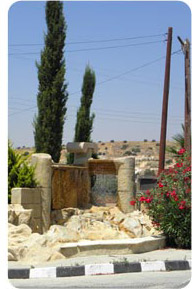
The
village of Maroni is found built about 35 kilometers southwest
of Larnaca. It has an average altitude of 70 meters, the
altitude reaching 200 meters in the north of the village,
and has a distance of 2 kilometers from the sea.
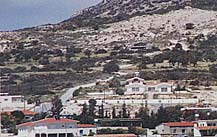
The village receives an average annual rainfall of
about 380 millimeters; citrus fruits (lemons, grapefruits,
oranges), cereals, forage plants, olive and locust trees,
and various types of vegetables are cultivated in the
region. Several greenhouses have been installed in the
area for the cultivation of early vegetables. Stockbreeding
in the village is limited. There are four units of sheep
and goat breeding, two poultry farms, a hatchery, and
an ultramodern pigsty.
Maroni is included in the irrigation project of Basilico-Pentaschino
and has benefited from it with the irrigation of considerable
range of land. Plans for re-allotment of the land have
been applied in regions covered by the irrigation project.
As far as transportation is concerned, the village
is connected to Zygi in the southwest, to Psematismenos
in the northwest and from there to the Limassol-Nicosia
highway.
Maroni
has undergone great fluctuations of its population.
In 1881 the inhabitants of the village were 303, which
increased to 329 in 1891, to 395 in 1901, to 430 in
1911, to 453 in 1921, and to 483 in 1931. In 1946 the
inhabitants of the village numbered 576 of which 434
were Greek-Cypriots and 142 were Turkish-Cypriots. In
1960 the inhabitants were reduced to 526 (423 Greek-Cypriots
and 103 Turkish-Cypriots). After 1964, because of the
inter-communal unrest that followed the Turkish-Cypriot
mutiny, the Turkish-Cypriot inhabitants of Maroni abandoned
the village and moved to neighboring -also mixed population
-villages. In 1973 the inhabitants of Maroni, all of
them Greek-Cypriots, were 322, which increased to 348
in 1976 to be reduced to 336 in 1982. In the 2001 census
the inhabitants of the village were 530.
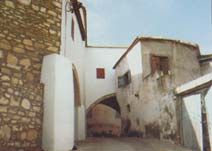
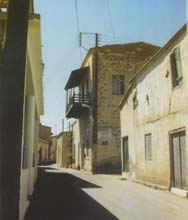
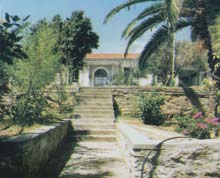
The
village preserves -to a great extend -its traditional
architecture with the narrow streets, the stone-made
houses with local stone, the houses with the picturesque
upper levels with balconies, the arches and the front
doors with chiseled frames. In the context of preserving
this heritage, a large part of the old village has been
deemed as a landmark and many houses have been renovated
in the same style.
Maroni existed since the Medieval times. In old maps
it is found marked as Marova. According to De Masse
Latri, the village was a feud that belonged to Royal
estates during the period of Frank domination. However
he erroneously places it in the region of Kythrea.
Several
interpretations have been suggested about the name of
the village. One reports that it comes from a mythical
character that is mentioned in Odyssey and lived in
Thraca, Maronas, who was host to Ulysses. Another mentions
that it maintains the name Maronia from the ancient
city of Thraca and another interpretation reports that
it took its name due to Maronites probably living in
the region.
According to the Encyclopaedia of Cyprus, it is believed
that these opinions are not valid and that the village
was named after the Saint and martyr Maronas (the memory
of which the church celebrates on the 18th of July),
who also gave his name to the village Maronas of the
Pafos district.
There is no relation with the community of the Maronites of Lebanon, although Maronites settled -also -in Cyprus early on. However, there is no testimony for their existence in the area of the village.
The region is rich in antiquities and has been confirmed
that it was inhabited since the prehistoric times, indeed
quite densely, something due to the fertile land in
the valley of the river Maroni. It is also mentioned
that in the region, starting from the village and toward
the sea, there were remains of the Neolithic era, the
Chalcolithic, the Early and Middle Bronze Age, the Archaic
era, and the Roman and Medieval times. |